AI Meeting Notes and GDPR Compliance: What You Need to Know

If your team uses AI meeting transcription software, you're collecting and storing personal data—and GDPR compliance isn't optional if you work with EU clients or employees. This guide shows you exactly what GDPR requires, the real risks of non-compliance, and how to choose meeting software that protects your data.
We'll walk you through the compliance checkpoints, the concrete costs of violations, and the practical steps to stay safe.
Why GDPR Matters for Your Meeting Software—Even in Malaysia
- GDPR applies globally if you process data of EU residents—Malaysia location doesn't exempt you
- Personal data in meetings includes names, email addresses, voice recordings, and discussion content
- You are the data controller—you decide whether to record; the software vendor is the processor
- Enforcement is real: 4,321 GDPR complaints filed across EU in 2023 alone
- Fines are severe: €10–€20 million or 2–4% of global annual revenue for serious violations
- Reputational damage often exceeds the fine—clients withdraw trust in weeks
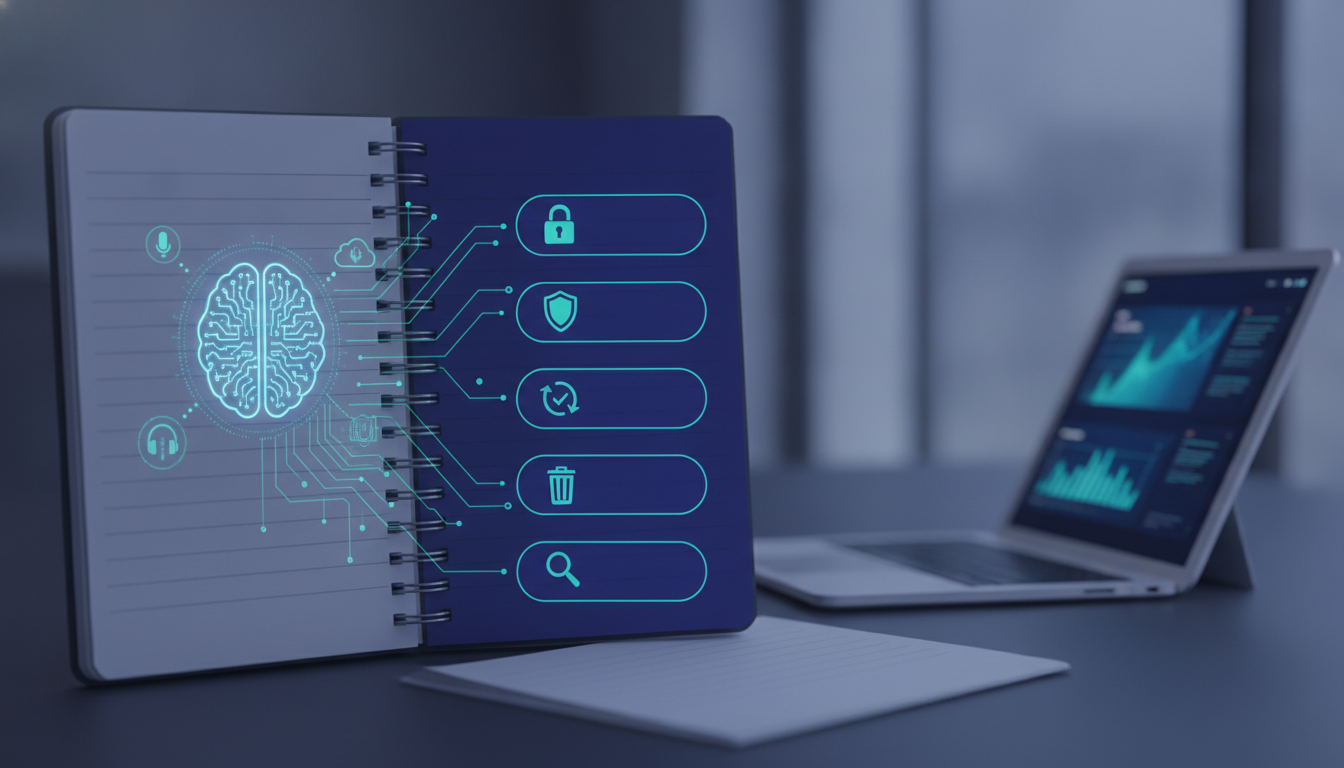
5 Core GDPR Requirements for Meeting Notes
1. Data Processing Agreement (DPA)
- Legally bind your software vendor to GDPR rules in writing
- Vendor must agree to only process data as you instruct
- Must cover sub-processors (third parties your vendor uses)
2. Encryption and Security
- Data must be encrypted in transit (TLS 1.2+) and at rest (AES-256 minimum)
- Software costing RM500–RM5,000/month must include these as standard
- Ensure vendor conducts annual penetration testing or ISO 27001 audit
3. Explicit User Consent
- Inform meeting participants *before* recording that notes will be made
- Get written consent—a pop-up or email confirmation counts
- Make opting out easy; don't bury consent in legal jargon
4. Data Retention Limits
- Don't keep recordings longer than necessary (typically 30–90 days)
- Auto-delete old files; don't archive indefinitely
- Document your retention policy in writing
5. User Rights and Accountability
- Employees/clients must be able to request, view, and delete their data
- Implement a process to handle "right to be forgotten" requests within 30 days
- Keep audit logs showing who accessed what, when
Red Flags: What Makes Meeting Software Non-Compliant
- ❌ No Data Processing Agreement provided by vendor
- ❌ Vendor shares data with US servers without Privacy Shield equivalent
- ❌ Automatic data sharing with marketing/analytics partners—even anonymised
- ❌ No encryption between your device and vendor's cloud
- ❌ Data retention policy is vague ("we keep it indefinitely")
- ❌ No way for users to request data deletion
- ❌ Vendor cannot prove ISO 27001 certification or recent security audit
- ❌ Cost suspiciously low (under RM200/month) with no clear data handling policy
- ❌ Vendor located in non-GDPR jurisdiction with no EU subsidiary
How to Audit Your Current Meeting Software for GDPR Compliance
Step 1: Request a Signed Data Processing Agreement
- Email the vendor's legal team; demand a DPA within 14 days
- If they refuse or delay, flag them as high-risk
- Ensure the DPA covers your specific use case (internal meetings, client calls, training, etc.)
Step 2: Check Data Location and Servers
- Ask: Where are recordings and transcripts stored? (EU, US, Australia, etc.)
- Verify if data leaves the EU at any point in the pipeline
- Demand documentation proving encryption in flight and at rest
Step 3: Review Their Privacy Policy
- Look for: data retention timeline, deletion procedures, sub-processors listed
- If the policy is a generic template, assume they're not GDPR-ready
- Check if they monetise user data (e.g., sell insights to third parties)
Step 4: Verify User Consent Mechanisms
- Test the software: does it clearly ask permission before recording?
- Can meeting participants easily opt out or request deletion?
- Is the consent mechanism documented in your contracts?
Step 5: Request a Security Certificate
- ISO 27001, SOC 2 Type II, or equivalent audit report (dated within 2 years)
- Penetration test results from an independent firm
- If the vendor won't share, consider it a disqualifier
Practical Steps to Implement GDPR Compliance Today
1. Document Your Data Handling Process (Week 1)
- Create a 1-page policy: when you record, who sees notes, how long you keep them
- Share with your team and all meeting participants
- Store the policy in a shared drive with version history
2. Update Your Meeting Invitation Template (Week 1)
- Add a standard line: *"This meeting will be recorded and transcribed. By joining, you consent to participate."*
- Include a link to your data handling policy
- Offer participants the option to join audio-only (video off) if uncomfortable
3. Configure Auto-Delete Settings (Week 2)
- Set your meeting software to auto-delete recordings after 60 days
- Move sensitive recordings (layoffs, salary reviews, legal) to a separate folder with manual deletion
- Test the auto-delete function once before deploying
4. Train Your Team (Week 2)
- 30-minute session on what GDPR means for your software choice
- Teach employees how to handle deletion requests (answer within 10 days)
- Share the list of approved vendors; block others via IT policy
5. Audit Quarterly (Ongoing)
- Run a spot-check: pick 5 random recorded meetings, verify they're deleted on schedule
- Review user deletion requests; ensure they're completed on time
- Re-confirm vendor's DPA and security certification status annually
Choosing GDPR-Compliant AI Meeting Software: 3 Tier Options
Tier 1: Enterprise (RM3,500–RM8,000/month)
- Full DPA included; EU data residency guaranteed
- ISO 27001 + SOC 2 Type II certified
- Dedicated GDPR compliance officer available
- Examples: Otter.ai Enterprise, Microsoft Teams Premium with compliance add-ons
- Best for: Large teams, regulated industries (finance, healthcare), high-value client calls
Tier 2: Mid-Market (RM800–RM2,500/month)
- DPA available on request (usually within 7 days)
- EU servers with optional encryption add-on
- Annual security audit provided
- Examples: Fireflies.ai, Otter.ai Pro, Avoma
- Best for: SMEs with 10–50 employees, occasional EU client exposure
Tier 3: Startup / Self-Hosted (RM150–RM600/month or free)
- DPA rarely available; often requires legal negotiation
- Data location varies; US default in many cases
- No formal security certification
- Examples: Jott, Mem.ai, open-source transcription (whisper.cpp)
- ⚠️ High risk for GDPR if you process EU resident data—avoid unless you have a lawyer review
GDPR Compliance Checklist for Meeting Software
- Vendor has signed Data Processing Agreement (DPA) in place
- Data stored in EU or equivalent jurisdiction (verify server location)
- Encryption enabled: TLS 1.2+ in transit, AES-256 at rest
- ISO 27001 or SOC 2 Type II certification current (within 2 years)
- Auto-delete or manual retention policy set (maximum 90 days)
- User consent obtained before every recording (documented in email/pop-up)
- Team trained on GDPR obligations and vendor requirements
- Data deletion request process documented and tested (target: 10 days)
- Vendor sub-processors listed and approved in DPA
- Privacy policy reviewed and shared with all meeting participants
FAQ
Do we need GDPR compliance if we're only recording internal meetings with Malaysian employees?
Yes, if any participant is an EU resident or if you ever share recordings with EU clients/partners. GDPR applies whenever you process personal data of EU subjects, regardless of where your company is based. Even one German client attending a team call means GDPR compliance is mandatory.
What happens if we're caught violating GDPR with our meeting software?
Fines start at €10 million or 2% of global annual revenue; serious violations reach €20 million or 4%. Beyond fines, you face client contract breaches, loss of business, and reputational damage. A 2023 Irish DPC fine against Meta exceeded €1.2 billion for data handling violations—meeting software breaches are smaller but still costly.
Can we use a US-based meeting software without GDPR issues?
Not safely. US-based vendors are subject to American government data access laws (e.g., CLOUD Act). The Schrems II ruling (July 2020) invalidated the previous US–EU data transfer agreement. You'd need strong contractual safeguards (Standard Contractual Clauses) and vendor compliance with GDPR—possible but risky without legal review.
How do we handle a user's request to delete their meeting data?
Document the request in writing (email is fine). Within 10 days, confirm deletion with the user and your vendor. Keep a record showing the request date and completion date. If the data is subject to legal hold (e.g., litigation), you can delay deletion but must inform the user. GDPR requires 'right to be forgotten' compliance within 30 days.
Is a Data Processing Agreement (DPA) really necessary, or can we rely on the privacy policy?
DPA is mandatory. A privacy policy is a public document; a DPA is a binding legal contract between you and the vendor that specifies GDPR obligations (data location, sub-processors, breach notification, audits, liability). Without it, you're non-compliant. Most modern vendors provide one within 7–14 days on request.
What's the minimum retention period for meeting recordings to comply with GDPR?
GDPR has no minimum, only a maximum: keep data no longer than necessary. For most internal meetings, 30–90 days is reasonable. For regulatory meetings (e.g., board approvals, compliance checks), you may need longer—but document your business reason. After the stated period, auto-delete or manually remove the files.
Key takeaways
- GDPR applies globally to any company processing EU resident data—Malaysia location doesn't exempt you; violations cost €10–€20 million or 2–4% of global revenue.
- A signed Data Processing Agreement is legally mandatory; never rely on a privacy policy alone to claim compliance.
- Meeting software must encrypt data in transit (TLS 1.2+) and at rest (AES-256), provide clear user consent before recording, and support data deletion within 30 days.
- Mid-market compliant software costs RM800–RM2,500/month; enterprise-grade with full guarantees runs RM3,500–RM8,000/month; cheaper options often lack GDPR safeguards.
- Audit your current vendor now: request a DPA, verify server location, check ISO 27001 certification, and test the deletion process—implement changes within 4 weeks.